President Announces Deportation Relief for Millions

On November 20, President Obama made a long-awaited announcement detailing what steps his administration will take to provide relief from deportation for Americans without papers. The announcement included other steps the administration is taking within its legal authority to mitigate problems with the immigration system that so far Congress has been unwilling to tackle. Here are five major elements of the plan.

Continue reading “President Announces Deportation Relief for Millions”

Washington Kicks the Can Down the Road; States Take the Lead

President’s Decision to Delay Executive Action Creates Electoral Challenges

In early September, the President announced he would delay any executive action that would mitigate the failure of Congress to enact immigration reform, providing relief for families being split apart by deportation. The rationale given by the President was that the Central American child refugee crisis has affected the timeline for an announcement on executive action. Mr. Obama told NBC on September 6,

“I want to spend some time, even as we’re getting all our ducks in a row for the executive action… (and) make sure that the public understands why we’re doing this, why it’s the right thing for the American people, why it’s the right thing for the American economy,” Mr. Obama said.

Democratic Senators Urge Obama to Hold Off

Leading up to the decision to spend more time making sure the American people understand why executive action is needed, several Democratic incumbent senators and senatorial candidates in Republican-leaning states—among them Kay Hagan of North Carolina, Mark Pryor of Arkansas, Mark Begich of Alaska, Michelle Nunn of Georgia and Alison Lundergan Grimes of Kentucky—had been urging the president to hold off on taking action. They feared such a move would harm their electoral chances. In those states, the Latino electorate is small. The only state where there is a competitive Senate race this year and a significant pool of Latino voters is Colorado. Democratic senators Bill Nelson of Florida, Al Franken of Minnesota, and Independent Angus King of Maine (who caucuses with Democrats) also expressed concerns.

Complicating matters is a turn in public opinion on immigration since the Central American refugee crisis began, with an uptick in the percentage of Americans favoring a focus on border security.

So, regardless of the American people’s understanding of the need for executive action, the political calculation weighed against action prior to the election.

Continue reading “Washington Kicks the Can Down the Road; States Take the Lead”

New Report Calculates Benefit of Citizenship to Cities

In conjunction with the launch of the Cities for Citizenship initiative, a new report was released on September 17 that touts the benefit of naturalization to America’s cities. The report, released by the National Partnership for New Americans, the Center for the Study of Immigrant Integration at the University of Southern California, and the Center for Popular Democracy, calculates the benefit of naturalization to the earnings of immigrants living in the three cities whose mayors lead the Cities for Citizenship: Los Angeles, Chicago, and New York. It also calculates the resulting economic benefit for those three cities.

Continue reading “New Report Calculates Benefit of Citizenship to Cities”

It could be worse

Periodically, journalists and others look at the test of U.S. History and Government given to aspiring U.S. citizens. The questions is asked, “How well do native-born Americans know this material?” The answer invariably is, not well.

Still, the U.S. citizenship process is straightforward and simple in comparison to some other countries.

SwissflagIn the Swiss National Museum in Zurich, there is a fascinating display of Swiss citizenship requirements. According to the exhibit, while there is a national uniform naturalization law, the majority of the 2,600 political communities (cantons—equivalent to our states—and municipalities) apply their own naturalization policy.

When an applicant is ready for citizenship, he or she is often interviewed and questioned about the municipality, the canton, and the nation. Sometimes, the process includes a surprise home visit. In some cantons, the interview is replaced by a test.

Continue reading “It could be worse”

As Hope for Reform Fades, Administrative Action Becomes More Likely

On June 30, President Obama made remarks in which he criticized the failure of House Republicans to “stand up to the Tea Party in order to do what’s best for the country” and pass an immigration reform bill. He said that he would begin a new effort “to fix as much of the immigration system as I can on my own, without Congress.” He directed DHS Secretary Jeh Johnson and Attorney General Eric Holder to move resources to the border, and to make additional recommendations by the end of the summer, after which he will adopt those recommendations “without further delay.”

The president made this announcement after he was informed that Republicans would block a vote on an immigration bill at least for the remainder of the year.

Continue reading “As Hope for Reform Fades, Administrative Action Becomes More Likely”

Despite Cantor Loss, Reform Still Alive in Congress

It has been nearly a year since the Senate passed a sweeping immigration overhaul on June 27. The House has yet to act. The cause of the delay continues to be the internal divisions within the Republican Conference, with a sizable numbers of the conference opposed to reform.  Many members of Congress are now waiting to see how the primary season will turn out. Will members who have voiced support for immigration reform retain their positions?

Republican primary elections have yet to offer clarity on support for reform

On June 10, the small-tent faction of the Republican party, or the “tea party,” celebrated victory in Virginia’s 7th Congressional district, where a poorly-funded tea party challenger beat the Republican Party’s second-highest-ranking member in the House, Eric Cantor. Cantor was seen as a supporter of reform, although he played both sides of the issue during his campaign. Still, his opponent attacked Cantor’s support for “amnesty,” and Cantor’s loss has given the press more reason to declare immigration reform officially dead.

On the other hand, other primaries have yielded the opposite results for candidates who have been supporters of reform. On the same day that Cantor lost, one of the leaders in pushing reform legislation through the Senate, Lindsey Graham, very comfortably won his primary in South Carolina. Graham received 57 percent of the vote, far ahead of the 15 percent received by the second-place finisher in a field of six challengers.

Continue reading “Despite Cantor Loss, Reform Still Alive in Congress”

Naturalization: The Latest Official Statistics

On June 3rd, the Office of Immigration Statistics of the Department of Homeland Security released its fiscal year 2013 statistics on naturalization. These statistics give us a look at how many persons are becoming citizens, what are the top countries of origin, and which states and cities have the most new Americans.

How many are naturalizing?

Natzgraph

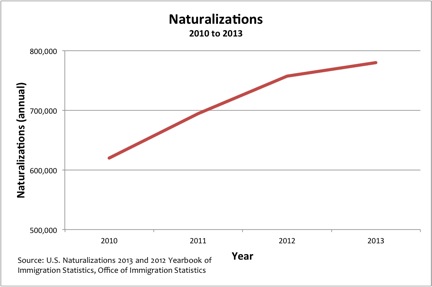
In the government’s fiscal year 2013 (which ended September 30, 2013) 779,929 immigrants became citizens. This is a slight increase from the year before. In fact, since 2010—when naturalizations dipped to their most recent low point after the government caught up with a surge in applications caused by a hike in the application fee—naturalizations have been steadily increasing. Still, the number of immigrants being naturalized is not quite keeping pace with the number who are becoming permanent residents—a little more than one million per year in recent years.

Who is naturalizing?

Mexico is the top country of origin for our newly naturalized citizens. In 2013, India replaced the Philippines as the number two country of origin, but those three countries have been in the top three for the past three years.

More women than men became new citizens, and that is no different than the previous two years. In 2013, 55 percent of new Americans were women. Nearly two-thirds of new Americans were married.

Where are immigrants naturalizing?

Not surprisingly, the top three immigrant gateway states of California, New York, and Florida are also the top three states for new Americans. In 2013, nearly 165,000 immigrants became citizens in California alone. The top five metropolitan areas in which immigrants are becoming citizens are New York, Los Angeles, Miami, Washington, and Chicago.

The paper from the Office of Immigration Statistics is available here.

This article was written for the National Immigration Forum, and appeared on the website of the New Americans Campaign.

Reading the Tea Leaves on Immigration Reform

As Congress returns from a two-week recess, we are still awaiting movement on immigration reform in the House. While there is still no sign of concrete accomplishment in the House, the tension between the two factions of House Republicans continue to break the surface and create news for immigration reporters always looking to write immigration reform’s obituary.

An example: Jeb Bush, former governor of Florida and a potential Republican presidential candidate, created a stir when he said of undocumented immigrants,

“Yes, they broke the law, but it’s not a felony. It’s an act of love. It’s an act of commitment to your family. I honestly think that that is a different kind of crime that there should be a price paid, but it shouldn’t rile people up that people are actually coming to this country to provide for their families.”

As usual, any suggestion that undocumented immigrants be treated with something less than mass deportation caused some on the right wing of the Republican Party to have an apoplectic fit. However, there were also prominent voices within the party who came to Mr. Bush’s defense.

Continue reading “Reading the Tea Leaves on Immigration Reform”

African Immigrants and the American Mosaic

An article from the March 25 Boston Globe is a reminder that America is increasingly diverse.

“On the hard road to US citizenship, black immigrants are increasingly gaining ground in Massachusetts and the United States, expanding the possibilities for political power and changing what it means to be black in America.”

In Massachusetts, according to the Globe, black immigrants comprise about a third of the black population, and a majority of black babies born today have an immigrant mother. While Massachusetts is way ahead of the nation in these statistics, more black faces are appearing at swearing-in ceremonies for new citizens all across the country.

Immigrants from Africa and the Caribbean are still a small part of our immigration stream. Until recently, few Africans had close family members in the U.S. to sponsor them through an immigration system that favors close family ties. However, Africans have benefited from two other immigration streams.

In recent years, the U.S. has accepted more Africans as refugees than in the past. In 2011, more than 7,500 refugees were admitted to the U.S. from Africa.

Africans have also been big winners in the annual visa lottery. This system was set up specifically to mitigate effects of a family immigration system that has been dominated by relatively few countries. In 2011, more than 24,000 Africans gained immigrant status through the visa lottery, far more visas than immigrants from any other region of the world.

Immigrants entering the U.S. through these two streams will be able to sponsor family members, so Africans will increasingly have access to the family immigration system.

When it comes to citizenship, there is an accelerator effect that pertains to Africans: According to the Office of Immigration Statistics, African immigrants spent the least time in legal immigrant status before applying for citizenship—five years. Basically, this means that, generally, African immigrants apply for citizenship as soon as they are eligible. The norm for all immigrants is seven years.

All this means that, in the citizenship ceremonies of the future, we will see more African faces as America becomes even more diverse.

This article was written for the National Immigration Forum, and was published on the website of the New Americans Campaign.

With Reform Stuck in the House, Pressure Increases on the President

IMG_0407

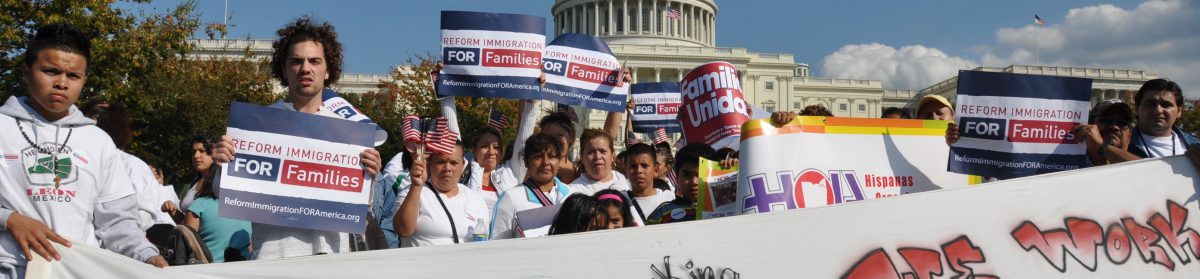
With the clock ticking on immigration reform in this Congress, House Republicans show no sign of bringing immigration reform legislation to a vote. Advocates, while still pushing House leaders to act, have begun to turn their attention to the president.

Since his State of the Union Address, the president has repeatedly promised to use his executive authority to do what he can on any number of issues that remain stalled because of congressional inaction. Immigration advocates—and some members of Congress—are urging him to use his executive authority to mitigate the suffering endured by families due to the broken immigration system.

President Obama has, up to now, maintained that he has limited authority to stop deportations. However, on March 14, the president met with reform advocates and told them he has ordered a review, in search of a more “humane” deportation policy.  Possible changes being considered, according to press reports, include the easing or stopping the deportations of persons who have no criminal convictions other than immigration violations and a limitation on immigration detainers. Experts—including former ICE Acting Director John Sandweg—have proposed other shifts in policy that would help ease the burden on families.

Continue reading “With Reform Stuck in the House, Pressure Increases on the President”