Republican Primary Messages Contradict Public Support for a Path to Citizenship

The first half of 2015 is nearly over. So far this year, the immigration debate has been dominated by President Obama’s executive action on immigration and Republican efforts to stop it. Republican state leaders have been successful in using the courts to temporarily halt the president’s action. Congress has drafted legislation to overturn the President’s actions. Presidential races are underway, and many candidates for the Republican nomination have vowed to end the President’s order.

Between last year and this, the focus of the immigration debate has changed. Last year, it was legislation moving through Congress that would have offered long-resident undocumented immigrants a path to citizenship, provided they could meet certain conditions. Conservative Republicans were successful at killing reform.

This year, with Congress seeming incapable of reforming the immigration laws, the President has acted to protect, at least temporarily, some of the same long-resident undocumented immigrants who would have benefited from the legislation. Again, conservative Republicans are trying to stop relief for these aspiring Americans.

It’s time to take another look at how the public feels about all this. By looking at several public opinion polls since the beginning of the year, it is clear that the public’s attitude has changed very little from last year to this. There is majority support for allowing undocumented immigrants to stay in the U.S. legally.


Continue reading “Republican Primary Messages Contradict Public Support for a Path to Citizenship”

Jeff Sessions: Champion of the American Worker? Really?

Senator Jeff Session (R-AL) has been the Senate’s leading opponent of comprehensive immigration reform. He now chairs the Senate Judiciary Committee Immigration Subcommittee. On April 9, Senator Sessions published an opinion piece in the Washington Post, laying out his case against legal immigration.

During the immigration reform debates in previous congresses, Mr. Sessions has been an ardent opponent of giving our long-resident undocumented immigrants a way to gain legal status. In this piece, he touts his opposition to legal immigrants as well.

As is typical of immigration restrictionists, Mr. Sessions cloaks his anti-immigrant inclinations in arguments supporting the American worker. Let’s look at a couple of those arguments.

Continue reading “Jeff Sessions: Champion of the American Worker? Really?”

Congress Has Abandoned Policy-Making Responsibility for Immigration. So Who’s Making Policy?

US Capitol Building with We are Closed Sign on US American Flag Background Illustration

Updated April 8.

With Congress abandoning its policy-making responsibility for immigration, policy-making initiative now rests with the executive, the states, localities, and the courts.

While Washington has been preoccupied with a fight over the president’s Executive Actions on Immigration, there is more activity on the immigration front than the president’s decrees. That activity is happening in 50 states, and in many more communities.

On March 29, Julia Preston of The New York Times wrote a nice summary of how immigration policy in this country diverges greatly among the states. She contrasts the lives of two undocumented women—one in Washington, which has enacted policies that are welcoming to immigrants, including one allowing undocumented immigrants to obtain drivers licenses, and one in Texas, which has brought a lawsuit against the president to stop his immigration executive actions.

In general, states are divided by where immigrants live. States with significant immigrant populations, including significant populations of undocumented immigrants, tend to be more welcoming. The integration of undocumented immigrants is important to them. It is good for their economies. States with smaller immigrant populations tend to be less welcoming, and it is these states that have joined the Texas lawsuit against the president’s welcoming policies.

Continue reading “Congress Has Abandoned Policy-Making Responsibility for Immigration. So Who’s Making Policy?”

After Shutdown Drama, Congress Extends DHS Funding

On March 4, President Obama signed legislation to fund the Department of Homeland Security for the remainder of the fiscal year ending September 30. The legislation had previously passed the Senate (on February 27) and the House followed on March 3rd—but only, after weeks of chaotic brinksmanship during which the most conservative members of the Republican caucus demanded that DHS not be funded until President Obama’s executive action on immigration was overturned.

Technically, the House voted to “recede” to the Senate’s position on not going to a House/Senate conference committee and to “concur” with the Senate bill.

House bill fails in Senate

The scene was set on January 14, when the House passed, along party lines, a DHS funding bill that contained provisions to roll back the president’s executive actions on immigration. The bill then went over to the Senate, where it is much more difficult to pass bills that are strictly partisan. Indeed, Senate Majority Leader Mitch McConnell attempted four times to bring the House bill to the floor of the Senate, but lost a procedural vote each time. On February 27, the day DHS funding was due to expire, the Senate considered a funding bill stripped of the controversial House provisions, and it passed in a bipartisan 68 – 31 vote.

Continue reading “After Shutdown Drama, Congress Extends DHS Funding”

Judge Rules Against Executive Action, Preserving the Status Quo

On February 16, U.S. District Court Judge Andrew Hanen issued a temporary injunction against two of President Obama’s executive actions on immigration: the expansion of Deferred Action for Childhood Arrivals (DACA) and new Deferred Action for Parents of Americans (DAPA).

The case was brought by the Attorney General of Texas, joined by 25 other Republican-led states. The ruling was not unexpected; the plaintiffs were able to shop around for a judge that would likely rule in their favor, and Judge Hanen’s negative views towards the administration’s immigration policies are well known.

The administration will likely appeal, and the plaintiffs will not be able to shop for a judge at the appellate level.

In the meantime, those two programs are on hold. The administration was going to begin taking requests in the expanded DACA program on February 18. It will have to hold off.

Continue reading “Judge Rules Against Executive Action, Preserving the Status Quo”

Don’t Believe in Global Warming? Stick with Something Safer—Like the Lottery

Slot Machine

On January 16, The New York Times reported that the National Aeronautics and Space Administration (NASA) and the National Oceanic and Atmospheric Administration (NOAA) released independent compilations of data confirming that 2014 was the warmest year on record, measuring average global earth surface temperatures.

Climate skeptics are now busy developing new spin to brush off this new data, but it gets harder. Skeptics like to say that global warming has essentially stopped since 1998, but 2014 displaced 2010 as the record-holder, and the ten warmest years on record have all occurred since 1997.

The same article noted that the last time there was a month in which average global surface temperatures were below the global average was February 1985. The last year with below average temperatures was 1976. I was in college.

Not long ago, my wife and I were at a party in which we were talking about New York State wines. One of us made a joke about how many more varieties of grape will do better in New York with global warming. The woman we were talking with replied, “If you believe in global warming.” We initially thought she was joking, but we were at a party where a lot of people get their news from a source that might not put out the most accurate information on this subject.

OK, here’s a fun math exercise. Let’s say global warming is not happening. In any given month, there is an equal chance that the average global temperature will be above or below the long-term average. Odds that you will randomly get two months in a row that are above average are 1/22, or one in four. Pretty good odds. The odds that you will have four consecutive months above or below average are 1/24, or one in sixteen. Still pretty good odds.

But we’ve had 358 consecutive months of above average temperature. What are the odds? As you might have guessed by now, they are 1/2358, or (approximately) one in 587,100,000,000,000,000,000,000,000,000,000,000,000,000,000,000,000,000,000,000,000,000,000,000,000,000,000,000,000,000, 000,000,000,000,000,000.

By contrast, your chances of winning the lottery are much greater. For example, your chances of winning the jackpot in the New York State mega millions lottery are one in 258,890,850.

So, if you don’t believe in global warming, just don’t bet on it.


Image thanks to Flickr member Jeff Kubina.

New Research Shows Low-Income Naturalization Rates Lagging After Fee Increase

Img_15-0109

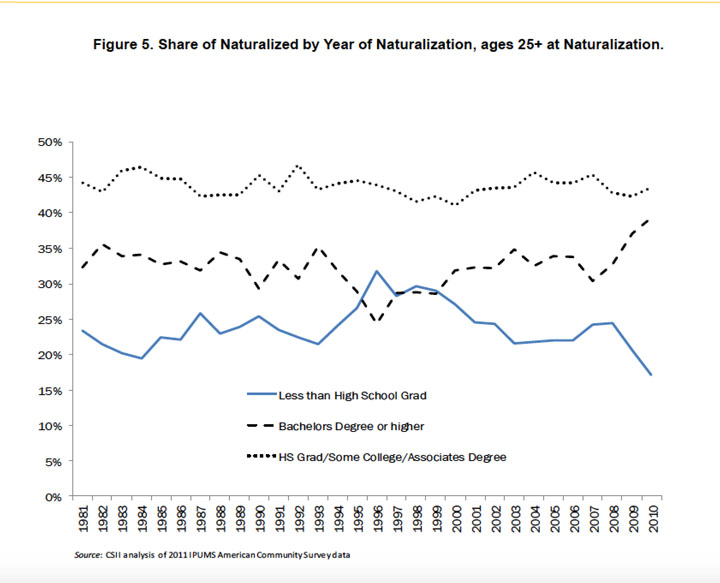
Advocates and service providers who help immigrants become citizens say that the application fee for citizenship, now $680, is a barrier to naturalization for low-income immigrants. New research by Manuel Pastor and Jared Sanchez of the University of Southern California (USC) and Patrick Oakford of the Center for American Progress (CAP) shows that the number of low-income immigrants naturalizing is lagging that of immigrants with higher incomes. Read more at this post written for the New Americans Campaign.

Action/Reaction: Public Support, Republican Opposition to Executive Action

The least productive Congress in modern history will leave Washington this week for the holidays. After running the clock out on this Congress without action on immigration reform, Republicans have been predictably furious at President Obama for taking action to mitigate the hardships caused by their lack of action.

Continue reading “Action/Reaction: Public Support, Republican Opposition to Executive Action”

President Announces Deportation Relief for Millions

On November 20, President Obama made a long-awaited announcement detailing what steps his administration will take to provide relief from deportation for Americans without papers. The announcement included other steps the administration is taking within its legal authority to mitigate problems with the immigration system that so far Congress has been unwilling to tackle. Here are five major elements of the plan.

Continue reading “President Announces Deportation Relief for Millions”

Washington Kicks the Can Down the Road; States Take the Lead

President’s Decision to Delay Executive Action Creates Electoral Challenges

In early September, the President announced he would delay any executive action that would mitigate the failure of Congress to enact immigration reform, providing relief for families being split apart by deportation. The rationale given by the President was that the Central American child refugee crisis has affected the timeline for an announcement on executive action. Mr. Obama told NBC on September 6,

“I want to spend some time, even as we’re getting all our ducks in a row for the executive action… (and) make sure that the public understands why we’re doing this, why it’s the right thing for the American people, why it’s the right thing for the American economy,” Mr. Obama said.

Democratic Senators Urge Obama to Hold Off

Leading up to the decision to spend more time making sure the American people understand why executive action is needed, several Democratic incumbent senators and senatorial candidates in Republican-leaning states—among them Kay Hagan of North Carolina, Mark Pryor of Arkansas, Mark Begich of Alaska, Michelle Nunn of Georgia and Alison Lundergan Grimes of Kentucky—had been urging the president to hold off on taking action. They feared such a move would harm their electoral chances. In those states, the Latino electorate is small. The only state where there is a competitive Senate race this year and a significant pool of Latino voters is Colorado. Democratic senators Bill Nelson of Florida, Al Franken of Minnesota, and Independent Angus King of Maine (who caucuses with Democrats) also expressed concerns.

Complicating matters is a turn in public opinion on immigration since the Central American refugee crisis began, with an uptick in the percentage of Americans favoring a focus on border security.

So, regardless of the American people’s understanding of the need for executive action, the political calculation weighed against action prior to the election.

Continue reading “Washington Kicks the Can Down the Road; States Take the Lead”